The Grammar of Theosis: St Irenaeus & St Athanasius

Few doctrines have been more central to the Christian tradition—and yet more variously expressed—than deification. From the earliest centuries, Christian writers spoke of salvation as participation in the divine life, as becoming “god” by grace. Yet the conceptual grammar of this claim is far from uniform. The Fathers do not offer a single, stable account of how such participation is possible. Instead, they speak in multiple registers.
This plurality is brought into sharp focus in the work of Norman Russell. In both The Doctrine of Deification in the Greek Patristic Tradition (2004) and Fellow Workers with God (2009). Russell demonstrates that theosis is not a monolithic doctrine but a complex field of related concepts and practices. The Church Fathers share a common conviction—that salvation consists in participation in the divine life—but they articulate this claim through a range of approaches not easily reducible to one another. Russell’s own analysis classifies these approaches in terms of nominal, analogical, ethical, and realistic forms, offering a valuable map of the tradition’s internal diversity.
Yet a map is not yet an ordering principle. The question remains: how are these different accounts related? Do they represent complementary perspectives on a single underlying structure, or do they reflect deeper divergences in how participation in God is understood?
I am approaching this question from a different, though hardly original, angle. I propose that the patristic accounts of deification may be distinguished by the locus and mediation of participation—that is, by where participation in God is understood to occur and how it is effected. On this basis, four broad models may be identified: Incarnational, Transformational, Metaphysical, and Energetic.
In the Incarnational Model, participation in God is grounded in the person of Christ himself. The union of divine and human in the incarnate Word constitutes the ontological basis of deification. Human beings come to share in the divine life of the Father through incorporation into Christ by the Holy Spirit. This model, developed most clearly in St Irenaeus of Lyons, St Athanasius the Great, and Cyril of Alexandria, presents deification as participation in the Son’s filial relation to the Father.
In the Transformational Model, participation in God is located primarily in the transformation of the human subject. Deification is understood as assimilation to God through moral, ascetical, and contemplative progress—a movement from image to likeness. Though it presupposes the Incarnation and the ministry of the Spirit, the emphasis lies on the ascetical and spiritual struggles of believers to conform themselves to Christ. Exponents of this model include St Gregory the Theologian, St Gregory of Nyssa, and Evagrius Ponticus.
In the Metaphysical Model, participation is grounded in the structure of being. Creation is understood as ordered from and toward God, and deification is the fulfillment of this ontological orientation. In St Maximus the Confessor, its principal exponent, this takes the form of a comprehensive vision in which all things possess their logoi in the Logos and are drawn toward their consummation in him. This model integrates cosmology, anthropology, and Christology into a unified framework, but it also introduces a certain ambiguity: participation can be read either as explicitly grounded in the incarnate Christ or as articulated within a more comprehensive ontology of participation.
In the Energetic Model, theosis is formalized through a real distinction in God between his essence and energies. Deification is understood as participation in the uncreated energies while the divine essence remains transcendent and incommunicable. This model, associated with the later Byzantine tradition and articulated most fully in the fourteenth century by St Gregory Palamas, provides a metaphysical resolution to the problem of how creatures can truly participate in God without collapsing the distinction between Creator and creation.
These models are not mutually exclusive, nor do they represent discrete historical stages. They overlap, interact, and develop in complex ways across the tradition. Yet they are not simply different expressions of the same underlying structure. They reflect distinct ways of locating and mediating participation in God and therefore carry different theological implications.
As already stated in my article on St Cyril of Alexandria, “Theosis as Trinitarian Communion,” I will be arguing in this series that among these different models, the Incarnational model best embodies the grammar of the faith and therefore should be the dominant approach employed by bishops and parish priests. By grounding participation directly in the person of the incarnate Son and actualized by the Holy Spirit, it fits, hand and glove, with the Nicene preaching of Christ and provides the ontological basis that the other models either presuppose, approximate, or seek to supplement. The later development of the Energetic model, in particular should be understood (contra modern Neo-Palamites), not as our primary expression of deification, but as a historically conditioned attempt to resolve tensions that arise when the grounding of participation is not consistently maintained at the level of the Incarnation.
The importance of Russell’s work lies precisely in making this plurality visible. He provides not a synthesis but a map. What remains is to ask whether the tradition’s many voices can be ordered around a more fundamental theological grammar—one capable of doing justice both to the unity of the Christian confession and to the diversity of its historical expression. To explore this more concretely, we turn to a series of representative theologians. In Irenaeus, Athanasius, Gregory of Nyssa, Maximus the Confessor, and Gregory Palamas, we can see these different models at work and begin to assess how they relate to one another within the larger tradition. These summaries are necessarily brief and neither capture the depth nor breadth of the presentations of their principal exponents, but hopefully they are sufficiently accurate for the purpose of this series.1 I am sure that genuine scholars, if any are reading these articles, will judge them woefully inadequate. Alas, I’m a blogger, dammit, not a patrologist!
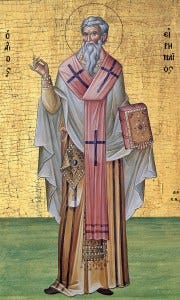
St Irenaeus: Adopting sons in the Son
The earliest patristic accounts of deification are marked by a strong emphasis on participation and transformation, yet they do not offer a fully developed conceptual or metaphysical account of the mode of participation in God. As a rule, these accounts stick close to the New Testament story of Jesus Christ as Lord and Savior.
St Irenaeus of Lyons presents deification within a firmly maintained distinction between God and creation. Human beings do not become God in an unqualified sense, nor is there any suggestion of a continuum between divine and human being. Rather, deification consists in participation in what belongs properly to God—above all life, incorruptibility, and immortality—granted through the incarnate Word. The emphasis falls not on identity with God, but on the communication of divine life and attributes to the creature. As Jeffrey Finch writes:
Although he never employed the language of theopoiesis or theosis, already present in the theology of Irenaeus are all the essential elements of what would come to be regarded as the characteristically patristic understanding of sanctification as divinization: restoration of prelapsarian likeness to God and incorruptibility, initiated by the union of human nature with divine nature through the incarnation, life, death, and resurrection of the Eternal Son, appropriated existentially as adoption by God and infusion by the Holy Spirit, and finally perfected eternally through the face to face vision of God.2
In Irenaeus, deification is grounded in the Incarnation and articulated through the doctrine of recapitulation. Humanity, created in the image of God, is called to grow into the likeness of God through participation in divine life. This movement is at once restorative and teleological: in recapitulating Adam and the human race, the Word “sums up” humanity in himself, restoring what was lost in the fall while bringing human nature to its intended fulfillment. Deification thus consists in the communication of divine life through union with the incarnate Son. The logic is expressed in the well known exchange formula: Christ becomes what we are so that we may become what he is—yet this“becoming” is by adoption, not by nature. The transformation is grounded in the historical Incarnation itself: God becomes human in order to restore human nature from within. The goal of this participation is therefore not assimilation to God as such, but the restoration and perfection of humanity in Christ. Those who are united to him are conformed to this perfected humanity. Deification names the fulfillment of the human according to the image of God as realized in the incarnate Son. This structure is stated with particular clarity by Irenaeus:
Those who say he is a mere man begotten by Joseph remain and die in slavery to the primal disobedience, not yet mingled with the Word of God the Father nor sharing in freedom through the Son, as he himself says: “If the Son set you free, you are truly free” (John 8:36). Ignorant of him who is Emmanuel born of the Virgin (Is. 7:14), they are deprived of his gift, which is eternal life (John 4:10, 14); not having received the Word of imperishability, they remain in mortal flesh; they are debtors to death, not receiving the antidote of life. To them the Word says, speaking of his gift of grace, “I said, You are all gods and sons of the Most High, but you die like men” (Ps. 82:6-7). He undoubtedly addresses those who do not accept the gift of adoption but despise the Incarnation, the pure generation of the Word of God, depriving man of his ascension to God and being ungrateful to the Word of God who became incarnate for them. For this the Word of God became man, and the Son of God [became] Son of man, that man, mingled with the Word and thus receiving adoption, might become a son of God. We could not receive imperishability and immortality unless we had been united to imperishability and immortality. And how could we have been united with imperishability and immortality unless imperishability and immortality had first been made what we are, so that what was perishable might be absorbed by imperishability and what was mortal by immortality (1 Cor. 15:53-54) “that we might receive adoption as sons” (Gal. 4:5)?3
Incorporated into Christ within the life of the Church, believers receive the Spirit and so receive the Creator as their Father. Denis Minns elaborates:
This adopted sonship obviously implies filial obedience, but it is not simply a restoration of a right relationship between God and his creatures. It is an incorporation into the natural sonship which is Christ’s as the only begotten son of God. Obviously, as creatures, we cannot be begotten of God in the way the divine Son is, but when Irenaeus speaks of our adoption as sons of God he does not mean that God simply chooses to look upon us as though we were his sons; he means that God has established us as sons by incorporating us into his only begotten Son. For this reason Irenaeus does not hesitate to say that when the Psalmist speaks of the ‘assembly of the gods’, he means by ‘gods’ ‘the Father, the Son and those who have been established as sons, that is, those who constitute the Church’.4
Irenaeus describes the result of this union in terms of incorruptibility, immortality, and filial adoption, emphasizing both its objective grounding in Christ and its progressive realization in the life of the believer. Participation is thus neither automatic nor self-generated, but mediated through the economy of salvation: the Incarnation establishes the bonding of divine life with human nature. Through faith and repentance, sinners come to share in that life.
This is the heart of Irenaean theosis: adoption as sons in the Son. Irenaeus presents salvation as the unfolding of a single divine economy in which the incarnate Word rescues humanity from corruption and death by appropriating it into his own immortal existence. “For the glory of God is the living man,” Irenaeus famously declared, “and the life of man is the vision of God. If the revelation of God by the creation already gives life to all the beings living on earth, how much more does the manifestation of the Father by the Word give life to those who see God!”5
St Athanasius: The Deifying Flesh of Christ
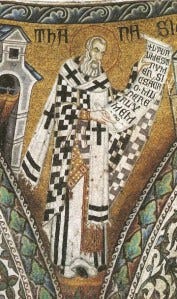
St Athanasius provides one of the clearest and most decisive early articulations of deification, grounding it directly in the Incarnation of Jesus Christ. His famous formula—“God became man that we might become god”—is a claim about what has been accomplished in the enfleshment of the eternal Word in Jesus Christ. Deification flows from the hypostatic union of divine and human nature. It is grounded in the consubstantiality of the the Father and the Son: only if the Jesus is truly God can we be brought into communion with the Holy Trinity. Athanasius’s defense of the homoousion is thus not an abstract metaphysical concern but a soteriological necessity. If Christ were a creature, he could not deify; only God can bestow life eternal. The reality of deification depends entirely on the full divinity of the Son:
But humanity would not have been deified if joined to a creature, or unless the Son was true God. And humanity would not have come into the presence of the Father unless the one who put on the body was his true Word by nature. Just as we would not have been freed from sin and the curse unless the flesh which the Word put on was human by nature—for there would be no communion for us with what is other than human—so also humanity would not have been deified unless the Word who became flesh was by nature from the Father and true and proper to him. Therefore the conjoining that came about was such as to join what is human by nature to what is of the nature of divinity, so that humanity’s salvation and deification might be secured.6
At the same time, Athanasius maintains a clear distinction between Creator and creation. Human beings become “gods”not by nature but by grace. The Creator–creature distinction is not erased but upheld even in the closest union. Deification is real, but it is always participatory and derivative.
For Athanasius, the fundamental problem faced by mankind is corruption and death. Humanity, created from nothing, is by nature subject to dissolution. Yet it was created for incorruption through contemplation of the Word, in whose image it was made. Sin disrupts this contemplation, and the result is not merely moral failure but ontological decay: humanity falls back toward non-being. Salvation, therefore, must address not only guilt but corruption itself. This is accomplished not by external intervention but by the Incarnation, in which the Word assumes human nature and heals and transfigures it. “For he received the humanity in such a way as to grant it exaltation,” Athanasius writes, “and this exaltation was its deification.”7 Athanasius consistently describes deification in participatory terms: what is joined to the Word shares in his life. The sanctified humanity of Christ becomes the locus of this transformation—death is overcome by the presence of life, corruption by the indwelling of incorruption. Deification, then, is not a change in the divine–human relation at the level of essence, but the result of union with the incarnate Word. Humanity does not become divine as God is divine, but is given to partake of the divine nature. Like Irenaeus, Athanasius also expresses this transformation in terms of adoption. The Son is Son by nature; we become sons through the gift of union with him. Deification is thus participation in the Son’s eternal relation to the Father. As the patriarch states:
God’s love of man is such that to those for whom first He is the Creator, He afterwards, according to grace, becomes a Father also. The latter he does when men, who are His creatures, receive into their hearts, as the Apostle says, the Spirit of His Son, crying, ’Abba, Father.’ It is these who, by their having received the Word, have gained from Him the power to become the children of God; for, being creatures by nature, they could not otherwise become sons than by receiving the Spirit of the natural and true Son. To bring this about, therefore, the Word became Flesh—so that He might make man capable of divinity.8
Sharing in the Sonship of Jesus, we now indwell his filial relationship with his Father:
Because of the grace of the Spirit which has been given to us, we come to be in Him, and He in us. And through His becoming in us, and we having the Spirit, it is reasonable that, since it is the Spirit of God, we are considered to be in God and God in us. Not then as the Son is in the Father, do we also become in the Father; for the Son does not merely participate in the Spirit in order to be in the Father. Nor does He receive the Spirit, but rather supplies it Himself to all. And the Spirit does not unite the Word to the Father, but rather the Spirit receives from the Word. And the Son is in the Father, as His proper Word and Radiance; but we, apart from the Spirit, are foreign and distant from God, and by participation of the Spirit we are knit into the Godhead.9
This “participation of God in the Spirit”10 is real, concrete, and personal. Athanasius emphasizes that the Word took human flesh so that human beings might be reborn from above: “‘For the Word became flesh’ in order that he may offer it for the sake of all and so that we, receiving from his Spirit, may be enabled to be divinized.”11 The transformation of human nature in Christ is not isolated to him alone: given human solidarity, it embraces all in principle. While Athanasius does not develop a detailed sacramental theology in the same way as later writers, he clearly affirms that communion with Christ is realized within the ritual and ascetical life of the Church. Believers are incorporated by baptism into Christ and thereby come to possess what he has accomplished.
Athanasius articulates the fundamental grammar of deification with a clarity made possible by the doctrinal settlement of the Nicene homoousion. The structure is simple and internally coherent: humanity is created for participation in divine life; this participation is forfeited through corruption and death; it is restored and secured in the Incarnation; it is actualized by the Spirit. In Jesus Christ, humanity is now granted access to joyous communion with the Father in the Spirit. A century later, St Cyril of Alexandria will unfold this same grammar through his expansive interpretation of the scriptural narrative—especially in the Gospel of John—and embed it in the sacramental life of the Church.
The Athanasian model of theosis achieved a normative clarity for the subsequent tradition, both East and West. Yet it does not resolve the metaphysical question of how such participation is to be conceived. The grammar is fixed; its conceptual elaboration is not. As the tradition develops, deification in Christ is rendered in diverse forms—sometimes extending this framework, sometimes reconfiguring it under new theological pressures. We now turn to these developments.
Endnotes
1 In writing this article, I must be upfront about my relative incompetence. I am not a patristic scholar and my reading of the Church Fathers is limited. I am therefore forced to rely on the scholarship of those who do possess the necessary competence. I have found Norman Russell’s books on deification enormously helpful, but so have the writings of many others.
For those who would like to explore this subject further, I recommend, in addition to Russell’s books, the following: Daniel A. Keating, Deification and Grace (2007), Partakers of the Divine Nature, ed. Christensen and Wittung (2008), Theosis: Deification in Christian Theology, ed. Finlan and Kharlamov (2006),
2 Jeffrey Finch, “Irenaeus on the Christological Basis of Human Divinization,” in Theosis, 86-87.
3 Irenaeus, Against Heresies 4.19; emphasis mine.
4 Denis Minns, Irenaeus (2010), 129.
5 Against Heresies 4.20.7.
6 Against the Arians 2.70.
7 Against the Arians 1.45.
8 Against the Arians 2.59.
9 Against the Arians 3.24.
10 Letter to Serapion 24.
11 Athanasius, On the Council of Nicaea 14.